I came across this great cartoon outlining the Five Stages of #SocialMedia Adoption by Marketers from the brillant @tomfishburne, enjoy!

I came across this great cartoon outlining the Five Stages of #SocialMedia Adoption by Marketers from the brillant @tomfishburne, enjoy!
The emergence of social media has had a tremendous impact of how digital news is produced, consumed, and specifically around how the journalists behind the stories are pressured to re approach and modify their craft. This month, Edelman Media Network teamed up with two start ups NewsWhip and Much Rack and surveyed 250 working journalists, revealing that more than three-quarters of them feel increased pressure to get their stories shared on social media.
Employers are becoming increasingly dependent on social media for traffic. In September 2013 Shareaholic reported the eight biggest social referrers drove 16.4% of traffic to publishers’ sites, and a year later, that number had nearly doubled, to 29.5%. As the study revealed, journalists are now feeling the pressure to write “sharable & digestible” stories surrounding topics which are already trending and focusing on ways to develop headlines which demand attention.
Journalists are also being called upon to leverage their individual social media profiles and adjust how they approach their stories to aide in getting the stories the most possible shares across social media. 82% of survey respondents said they use images to make stories more searchable (click to tweet).
It’s a fact that 90% of the information transmitted to the brain is visually based (click to tweet), and the human brains processes images 60,000 times faster than text, a stat which I often share when discussing leveraging visual content within social media.
It’s no surprise the facts revealed within the study, and how social media has redefined journalism and publishing. As social media continues to become more prevalent many traditional media companies continue to struggle to keep up. Employers are becoming increasingly dependent on social media or traffic, and roles such as mine are here to help journalists, and the rest of the business stay up to speed with trends in social media. I think the study shares some great stats, and raises a great issue faced by journalists. What do you think? Please leave me a comment or tweet me your thoughts.
It’s important to constantly evaluate and optimize your best social media content to ensure your feeding content into an engaged and active audience. Whether you’re a large brand or a blogger, if you’re spending time creating and sharing content no one is interested in, well, you’re just waiting your time! Avinash Kaushik’s four major social media metrics were designed in a 2011 blog post to address the way in which we evaluate our social media performance. Both Moz and Buffer use Kaushik’s social methods within their social media marketing, and theres an analytics tool, True Social Metrics, based solely upon his metrics.
Kaushik’s four metrics are:
1) Conversion Rate: The number of conversations per post. For example, on Facebook, Google+, LinkedIn (comments), on Twitter (replies).
2) Amplification Rate– The number of reshares or retweets per post.
3) Applause Rate- The volume of ReTweets, Likes, +1’s, and so on.
4) Economic Value– The sum of short term revenue, long term revenue, and cost savings.

Kaushik’s four metrics can be found across every social channel as they are independent of the individual social media networks. The four metrics are now more easily measurable due to tools and free analytics such as:
It’s important to consider Kaushik’s four metrics, and review and evaluate your social media content to ensure it’s always optimized and functioning well. if you’ve got a tool or article you’ve read which has more information or insight, please share within the comments, or send me a tweet @MarissaPick. Thanks!
According to new research from the University of California in San Diego sharing an uplifting quote or status update on Facebook or other social media platforms can be contagious.

Emotions expressed online both positive and negative can be contagious. Researchers reviewed the emotional content of 1 billion Facebook posts and found that the language used can influence the words your friends choose, creating what’s known as a “social multiplier.”
And researchers found that positive emotions spread more than negative ones. Make sure to think for a moment before you craft your next Facebook update, since it’s contagious after all!
We don’t have a choice on whether we do social media, the choice is how well we do it. -Erik Qualman
In his latest Installation and update of his famed Social Media Revolution video, Erik Qualman once again creates another fantastic video highlighting some key statistics. Erik reminds us that the four p’s of marketing (product, place, price, promotion) are disappearing while the four c’s of digital are emerging: creating, curating, connecting, and culture. As we plan our 2015 marketing campaigns it’s important to blend social media with a strong content marketing plan to maximize and captivate our audience.
Some highlights featured within the below video:
A social media strategy and a social media plan have a lot in common. A strategy is where you’re heading, and an effective social media plan should lay out how you’ll get there. When you’re coming up with a strategy it’s important to focus on business objectives, the platforms you’ll be using, and most importantly the below wheel of a crucial three- part idea. Once you come up with your strategy, you’ll need to implement it, and measure it, and think about it ongoing to always adjust and ensure it’s working. The below wheel is the most effective illustration i’ve seen to reinforce this idea.

You must always assess, implement, and monitor your strategy to ensure it’s working and effective. If you want to put it in simpler terms;
1) This is what we want to do
2) This is how we’re going to do it
3) This is how we did it
Repeat:)
I would love to know your thoughts, and how this wheel fits into your experiences building an ongoing social media strategy. Send me a Tweet @MarissaPick, or leave a comment below.
Over the past few years’ marketing automation has rapidly evolved and has enabled marketers much needed ease in performing daily tasks at work. One of the most important things to remember before embarking with marketing automation is to remember that it’s a technology not a strategy. It’s simply a tool available to help leverage the desired results from a more cohesive and planned strategy. Marketing automation should allow your brand and people the ease to take advantage of the efficiencies gained by focusing times and efforts on other parts of the business, while automating otherwise time consuming tasks.
Below are some of my do’s and don’ts of Marketing Automation.
Don’t commit email spam by merely automating the recipient’s first name, you must step up your game and deliver more personalized and engaging content. You must ensure emails sent through automation are customized for the individual reader, and leverage the sophistication of your platform. Your clients must feel as though they’re receiving communication from humans, not robots.
Do leverage data and analysis to make automation work for your brand. Review, revisit, measure and adjust to understand the full range of data triggers from your campaigns and get the most out of your automation. Take advantage of the rich behavioral data provided by marketing automation to create more focused, personalized, and successful campaigns.
Don’t automate the wrong things especially at the wrong times. Understanding when and where you audience lies is crucial before embarking on any campaign. It’s crucial to hit your audience through email when they’re most attentive based on past testing and analysis. When it comes to social media it’s important to take the time to write a compelling and appropriate channel for each platform. Avoid being a bot and posting irrelevant content when your audience is offline.
Do take advantage of workflows within your system and ensure you have a clear user journey set. People come into your sales funnel at different times and familiarity with your brand. Ensure you have clear paths set based on the leads past habits to allow them to progress through your sales funnel at their own pace. Use lead nurturing to setup re-engagement campaigns to revive interest in leads who have gone inactive. It’s crucial to use lead scoring and grading to automate leads qualification to further take advantage of seeing how good a fit they are for your brand, but how much they have engaged with your site.
Automating your marketing shouldn’t be an intimidating task, although it can seem daunting at times. When successfully leveraging all the resources available, you’ll quickly see the results pay off. I would love to hear your thoughts, please leave a comment or send a tweet @MarissaPick.
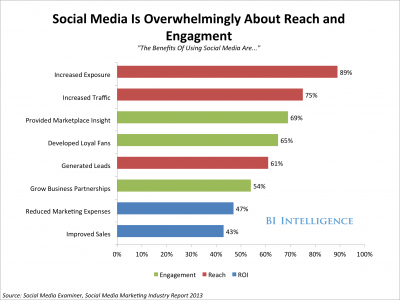
A fantastic article published by John Heggestuen in Business Insider reinforces the idea that Social Media Marketing isn’t always about the dollar value returns, but should be focused toward new metrics that evaluate social media strategies in terms of audience-building, brand awareness, and customer relations. It’s important to have clearly defined business objectives and realistic expectations before launching a social media strategy, and the points below really emphasize the larger picture of what marketers should be measuring.
The recent Business Insider report, In-Depth Research On What Matters In Digital reviews how social media strategies are involving:
The report also emphasizes the importance of reach and engagement as well as other benefits of social media below. It’s a great report to reinforce that in order to embrace social media you must see past the immediate revenue and dollar value returns, and see the larger picture!
Please leave a comment below, or tweet me @Marissapick with feedback, enjoy!
This week I had the honor of joining Paul Gillin and Allan Schoenberg for their FIR B2B Show #6 titled Marketers Struggle With Reinvention.
Paul and Allan discussed the latest in B2B and Social Media News covering:
1) Recent research from Demand Metric reinforcing the importance of lead generation as just 9% of B2B marketers say they are highly effective at generating leads..
2) A study from IBM which discusses that although CMOs believe that advanced analytics play a significant role in helping them reach their goals, most feel their organizations are not in a position to leverage data to its full extent to gain a deeper understanding of the customer.
3) A new research study of 350 business buyers by the CMO Council and Netline finds that third-party sources heavily influence B2B buying decisions. That’s not surprising, but what’s depressing is that only 9% said vendors are trusted sources of content. “Marketing executives unanimously agreed that a solid content strategy is imperative for building awareness it requires them to position themselves as trusted experts in their field,” the report concludes.
During this podcast we discussed the numerous channels we use at my company Euromoney Institutional Investor to leverage social media across our publishing and events businesses, as well as the power we’ve found through paid advertising on Facebook, and the importance of word of mouth marketing. Click the link below to listen to FIR B2B Show #6 “Marketers Struggle With Reinvention.”

Leave me a comment below or tweet me @MarissaPick to share your feedback with this FIR Podcast.
Earlier this month eMarketer posted a great article, Are You Still Missing a Strategy for Negative Social Posts? where they shared that most marketers respond within a day to negative posts. A staggering 88% of employees will use social media for marketing in 2014 however many still have trouble identifying ROI, but also responding to the negative buzz from the posts. At my current company we’ve had several instances where negative buzz has surfaced online, and we’ve had to quickly escalate to the proper internal resources to mitigate the situation. In responding quickly, we’ve turned online “ranters” to evangelists within a matter of days by promptly and effectively listening and responding to the issue at hand.
So what about the rest of you, are you responding online to negative posts? the Social Media Marketing University (SMMU) found that fewer than half of US marketing professionals had an effective plan for dealing with negative posts. The slide below shows the breakdown of where the marketing professionals align when asked in February 2014.

On top of having a strategy it’s impressive that 52% of marketers respond to a customer complaint on social media within 24 hours, and 18% respond within 1 hour. Click to Tweet this stat. A staggering 1 in 5 respondents said they rarely or never respond to negative social buzz altogether.
Do you have a strategy for responding to negative social media promotions online? If you don’t have a plan in place, I suggest you brainstorm and discuss one immediately. Connecting and engaging with clients and fans is a great way to deepen trust and loyalty while showing the human side of your brand. No one’s perfect, and mistakes happen and often customers can get upset and complain. With the growth and ease of social media networks customers now expect to log, share, and get resolutions through social media.
I’m curious to know how your brand deals with negative comments, and if you’ve got a strategy in place. Please comment below, log your vote in the poll, or tweet me @MarissaPick.
 Marissa's Picks