Five Steps to Improve Your Social Media Strategy

Have you ever wondered why some businesses succeed at social media while others fail? The difference is a solid social media strategy.  3 in 4 consumers make a buying decision based on online content wouldn’t you agree that consistency and a strategy is crucial?

Social media was once seen as the wild child of the marketing department but the times have changed and the industry has matured.  It’s a great place for brands to have a little fun but it also has a real and measurable impact of a businesses’ bottom line.

Social media can no longer live in a silo, it must work in tandem with the rest of your business strategy.  Whether you’re looking to reinvent your current strategy or you’re just looking to get started the five steps below will help you create results.

1) Define Business Objectives and Goals

The first order of business with developing a social media strategy is clearly defining your goals.  Goals are the fuel to propel your online efforts and they give context and purpose to what would otherwise be a random one off social media tactic.

Goal setting is a staple of all marketing and business strategies and social media is no exception.   Dr. Gail Matthews, a psychology professor at Dominican University in California conducted a study and found that you are 42 percent more likely to achieve your goals just by writing them down.

Surveying key business stakeholders and asking questions is essential. Prove your teams worth by tacking the questions head on and understanding business obstacles and social objectives that can help brands overcome them. Some questions to help you get started:

  • Who are you looking to connect with?
  • What are your goals of using social media?
  • How much time can you commit to managing your social media?
  • Who will be responsible for running your social media?
  • What does success look like?

2) Understand and Know Your Audience and Focus on Networks that Add Value

As you’re posting and sharing on social media have you taken time to determined if you have a defined focus? Do you really understand the needs of your target market?

The better you can describe your audience and potential clients or consumers the more likely that your message  will capture their attention.  As you develop your audience personas you’ll see that the problems you’re solving for each market will be considerably different.  Knowing exactly what your audience needs and ways to find and meet them is important while providing content or engagement in a real and specific ways.

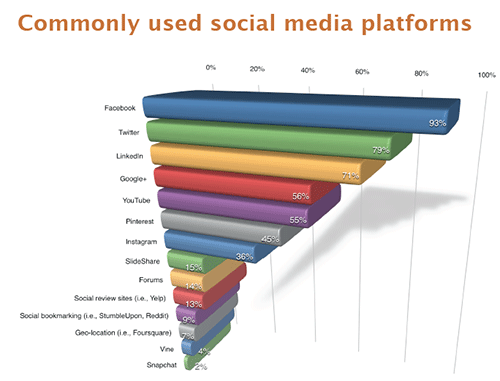
Each social network has its own strengths and weaknesses and each social media marketer should carefully pick and choose which networks they wish to take advantage of.

Each network provides a baseline of analytics to review your follow and fans online.  Simply asking your audience for their social media profiles is helpful as well as you’re capturing data with a registration form of other lead nurturing campaign.  Most CRM databased have places to house this information and as you’re segmenting and building audience specific campaigns this data will be essential for social media success.

3) Stand Out Online

In a busy and crowded social media world where a cookie-cutter approach is the norm, creating a differential as a way  to stand out online is a must.

The average attention span in 2000 was around 12 seconds but with the mobile and digital revolution it’s deteriorated quickly. Now, the average attention span of a human is eight seconds while a goldfish is believed to have an attention span of nine seconds. Source: National Center for Biotechnology Information. 

In order to use social media to its best, start by examining what your company means to your customers. You must determine not only what is unique about your business, but also how that uniqueness compels customer to keep coming back.

It’s important to review your messaging matrix daily to understand whether your message is benefitical and valuable or just contributing to the online noise.  Using social media effectively helps you stand out from the crowd. Understanding what makes your company, your culture and your customers unique will help you make your messages unique, too.

4) Create a Cross-Platform Strategy

It’s important to research and understand exactly how, when and why your audience is using social media.  Successful companies and brands determine where their time is best spent.  Understanding the audience and demographics and understanding how demographic groups use social media in a distinctive ways is crucial.  The bottom line? It’s vital to identify your customers preferred social media platforms so your strategy and focus and direct.

Just because a network has billions of users doesn’t mean it will have a direct contribution to your brand’s objectives. Instead of trying to be everything to everybody, focus your efforts on networks that hold the key to your target audience and objectives.

Social has long lived within the marketing department, but that doesn’t mean it can’t (and shouldn’t) have a hand in nearly every business function, from human resources to research and content marketing. To create a fully integrated social media marketing campaign, you’ll need to involve and integrate multiple departments, especially if your goals have a direct impact on them. Work with all your teams to determine how you can best support their goals and what key performance indicators are important to them.

5) Track, Measure and Adjust Along the Way

Tracking and measuring your social media efforts should be the backbone of your social media strategy. It’s sometimes difficult to measure and track social media success however setting clear KPI’s and updating often and along the way is crucial.  Social media is useful is useful in many ways, however it can turn into a tremendous time suck if you’re not paying close enough attention to where your time and effort is best spent.

That’s where analytics and analysis come into play.  Leveraging information available within your analytics dashboard to learn as much as possible about what content and actions are making the biggest splash across your social channels is key.  Evaluate how and why some content works and why some may fall short .

Takeaways: 

Sprout Social provided their readers the below seven step social media marketing checklist. It’s helpful if you’re reviewing your existing strategy and trying to determine how you check out.

Not everything will work on social media and that’s okay.  You can’t have success stories without failures along the way to provide a solid learning experience. The key to a successful strategy is to track, measure, and adjust along the way to determine what is working and how to do more of that.

Video and visual are must haves within my 2016 social media strategy, I’d love love to hear your thoughts on this piece and what you’re looking to do this year within your social media strategy.  Leave a comment or send me a tweet @marissapick.


Three Social Media Marketing Myths Debunked

Social Media is similar to Pandora’s Box.  It holds powerful tools which can help boost your business to new customers, retain loyal ones, and help to engage online within the digital world, or if can be a ton of wasted resources if not used properly.  Along with anything new comes a lot of misconceptions.  Although you maybe questioning the most efficient ways to maximize social media with your audience, don’t give up! Here are three major myths I come across which I’d like to take a stab at debunking.

Myth #1: I Don’t Have Enough Content to Fill my Social Media Feeds 

Social media outlets are fast paced and constantly changing.  Content gets posted online, flooded, pushed down, and becomes irrelevant quickly and before you know it.  Although this may seem like a wasted effort it reminds us that it’s important to repost the same content in different ways to best represent your brand.  Getting creative and thinking of interesting and exciting ways to share your content while avoiding making it seem too repetitive is important.  People often miss things, forget them, and if it’s evergreen content, then it’s always useful.  Putting a new spin and angle on how you repost it will help it live long and prosper. One of my favorite tools is pablo by buffer or canva, both can help quickly create visual content to accompany your content, and did I mention they’re both FREE.  Remember, the human brain processes images 60,000 times faster than text (click to tweet this) so visual content within social media is a MUST if you want to stand out and drive engagement!

Myth #2: My Social Media Channels Can’t Show Personality

Although your content should be targeted around your industry and demographic to best optimize, don’t be afraid to show personality.  Behind your brand you’ve got REAL people following you and engaging online.  Even if it doesn’t directly relate to your brand, product, or service spreading some humor can help to humanize your brand’s message.  We’ve found quotes, funny gifs, and office photos and interesting news articles helpful at CFA Institute.  Have a little fun, let your hair down, and get creative with your social media posts!

Myth #3: My Demographic Is Older, So Social Media Isn’t Relevant or Worth It

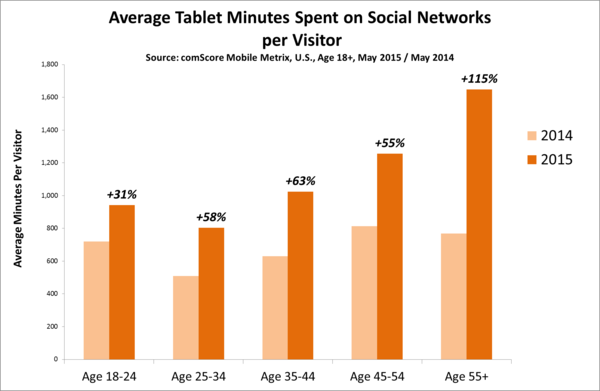
Contrary to what you believe, the older crowd is quite active on social media.  According to comScore Mobile Matrix the average tablet minutes spent on social networks per visitor is up 115% from 2015 in the 55+ age bracket.   According to FastCompany the fastest growing demographic on twitter is the 55-64 year age bracket (click to tweet this).  This demographic has grown 79% since 2012. For Facebook this group has jumped 46%, for Google+ 56%.

average-tablet-minutes-spent_reference

Not broadening your brand to reach an older age group, or ignoring their presence on social media outlets will severely limit your company’s potential for growth.

What do you think of these three myths debunked? Would love to hear your thoughts, leave a comment below or send me a tweet, thanks!

10 Types of Content we CRAVE!

If your content doesn’t resonate with your audience, then they won’t follow you where you want to take them.  For content marketers, this is a cardinal sin. It’s important to ask yourself what kind of content universally resonates with people.  Social Media is all about engagement, and driving conversation.  Content is fire, and social media is gasoline, so having a basic understanding of what resonate is imperative. Inspired by Scott Aughtmon’s post for Content Marketing Institute I created a list of 10 types of content we all love to consume.

  1. Content that tells us a story
  2. Content that inspires us to action
  3. Content that challenges our assumptions
  4. Content that evokes emotion
  5. Content that takes us along a journey
  6. Content which helps to educate as well as entertain
  7. Content which provides a fresh point of view
  8. Content that reveals secrets
  9. Content that encourages us to never give up
  10. Content that surprises us

It’s also important to keep the four rules below in mind as your creating content as you’re working to influence, inspire, and drive action.  You don’t necessarily need to have each of these types of content within each piece you produce, sometimes one is enough.

  • This is the kind of content we never get tired of.
  • This is the kind of content we always have time for.  
  • This is the kind of content we don’t forget.
  • And this is the kind of content we want to share.

I hope these provide some inspiration to get your content marketing in shape! Please leave a comment or send me a tweet and let me know what kind of content you crave!

Authority, Impact, and the Future of Influence Marketing

Influencer marketing is the most powerful tool in getting a brand’s message to an interested audience in a relevant and authentic way. Whether launching a new product or just trying to raise brand awareness, it’s effective in driving engagement, visibility,quality traffic, and more. Last week I spoke at ClickZ Live New York on Authority, Impact, and the Future of Influence Marketing.

The future of influence marketing is up and coming as marketers are trying to hone in on how to develop relationships with key influencers with hopes to lift awareness of their brands. It’s not enough to market through influencers, now it’s crucial to find a way to collaborate in partnerships with influencers.

Within my speech I discussed the four rules of influencer marketing:

1) Popularity Does NOT Equal influence.

2) To be influential, a person has to be actively writing on topics which matter to your audience.

3) To be influential, a person has to have authority.

4) Influencer’s drive action.

Platforms like Instagram and YouTube have led to the rise of a new generation of influencers that have amassed huge followings on niche subject matters. A research study by Nielsen showed that buyers trust experts and influencers over branded content. It’s important start a campaign with a precise set of goals, and understand the purpose of your influencer outreach plan.  Whether its to get them to be a brand advice, guest blog, or vouch for your brand you must begin by defining concise targets and have various KPI’s for various social media networks.

So how can you find Influencers? Great Question, here are some of my favorite (and free!) tools:

1) Follower Wonk Enables you to find, analyze, and optimize for social growth, and search bios of those influencers you’re after (especially very niche topics!).

2) Twitter provides free analytics which outlines top followers, influencers, and also gives a nice overview of your impressions, mentions, and more.  I also find using twitter lists to be an excellent way to tap into and influencer and “digest” twitter in a more streamlined manner.

3) BuzzSumo allows you to find the most shared content and see what content performs best, as well as discover key influencers.

4) Topsy is one of my favorite tools to search all tweets and measure social trends, but they’ve also got an influencer option which has proven quite helpful.

5) Klout is the original tool to rank influencers based upon social networks and reach, they’ve started a content first approach, but hey, I still get free perks, and i’m still a fan!

Once you’ve found your influencers it’s important to get closer and engage with them using social media.  Being socially active you’ll be one step closer to your influential audience.  When reaching out to an influencer you’ve got to recruit, initialize and grow your relationship, and then nurture. Make sure your outreach is relevant.  Taking time to research your target influencers interests, and understand who they are and what they like is crucial.  Engage on social media by sharing an article, providing an opinion, and engaging when them in conversation without an ask. Once you’ve built your initial conversation pitch free it’s important to reach out offline to discuss next steps, and if possible remind them of your discussion and engagement to spark the conversation.

My slideshare from ClickZ Live is below, and remember Jay Baer’s quote, “Content is fire. Social Media is Gasoline.” When done right tapping into this new generation of influencers can put your brand on the map, increase traffic, engagement, and so much more.

What do you think of the presentation, send me a tweet @MarissaPick, or leave a comment below.

Content Is Fire, Social Media is Gasoline

In 2013 Dave Kerpen shared a post on LinkedIn entitled Content Is Fire, Social Media is Gasoline.  Within the post he discusses the importance of keeping it real while also keeping it relevant. If your social media informs more often than it promotes, you’re on the right track. If it is deeply helpful rather than deeply promotional, you’re probably on a roll.

To get a better sense for how businesses can use content and social media together to be successful, Dave Kerpen asked Jay Baer to summarize the concepts of his book Youtility. Within the book he shares information regarding the concept of using marketing to promote your marketing.  Brands often talk too often on social media and miss the mark by never saying anything other than “we’re great” and “buy buy buy.” With so many updates constantly on social media brands are competing for attention, and can do so easily by being useful, not by shouting louder. 

Dave uses the company ExactTarget as an example, sharing two tweets back to back.  The first is a corporate message less relevant to a wider twitter audience.  The second is a real time tweet which created content on the most popular Olympic sports based on followers, which was sent during the London Olympic games.  The infographic has no information abut ExactTarget’s products and services, rather it used real time relevancy to create interest and to showcase some of it’s products (it has a software allowing companies to monitor and engage on twitter).

Content is everywhere, you can’t help but consume it within your everyday life.  Everyone has something they want to share with the world and we are constantly taking that information in.  We put content out there through the tools of social networks, leveraging sites like Twitter, Facebook, LinkedIn and so on.

“Content is fire. Social Media is Gasoline.” – Jay Baer

Jay-Baer-fire-gasoline

Social media is what sparks our message and keeps the fire burning faster and brighter. Our number one tool so get our content and our message out there is the social media, and once we start the process, we need to keep feeding our fire.

“You cannot create without first consuming something.” -Jill Falk

Within my role I’m consuming content about 90% of my day.  I wake up each morning and check my Twitter account before even stepping out of bed.  I download two newspapers each morning to read on my ipad during my 40 minute train each morning.  I often sit next to my husband silently who does the same, and shares some additional content he finds on the various apps he checks into such as flipboard or good reader.  At work I build social media strategies to help boost the content my company created, and I often get emails on my work and personal accounts with content my friends, family, and co-workers find interesting.

It’s part of my job to keep up with these things, and also get myself out there.  I send tweets more than I pickup a phone, and I am guilty of constantly checking and updating my social notworks, I admit it, i’m totally addicted.  I learn new things everyday using social media and it keeps me up to date with what’s going on in the world and what is going on with my friends and family.  After we delivered our son and shared the moment with close friends and family, hours later I posted a photo and watched it spread like wildfire, the texts, calls, and messages rolled in.  I remember turning to my husband totally overwhelmed and overjoyed with the amount of messages I had to respond too, and it took me almost two weeks to circle back with everyone!

I always remember Jay’s words, “Content is the fire, social media is the gasoline.” Keep feeding your fire and keep it going!  Do what you love, and enjoy!

Ten Eye Opening (and Tweetable) #Instagram Stats

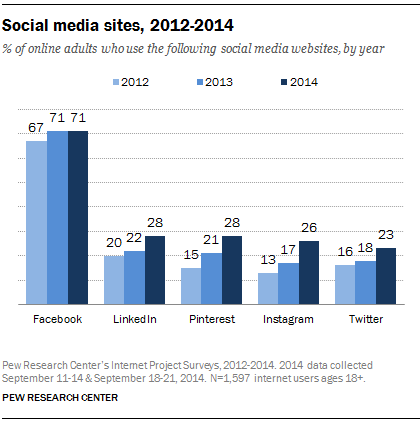
Data from the Pew Research Center shows that among social media networks, Instagram has surpassed Twitter in popularity among United States Adults.  The research states that 26% of online adults in the U.S. used Instagram in 2014, up 17% from the previous year, and 13% from 2012.  As a comparison 23% of online adults in the U.S. used Twitter in 2014.  The data finds that Facebook remains by far the social media site, however over the past year Instagram has made a splash, and engagement on Instagram is 15 times that of Facebook’s!

PI_2015-01-09_social-media_01One of the most interesting aspects of Instagram is that it’s not a site, but lives only on the mobile app.  Numerous brands have begun to use Instagram as businesses are seeing results from showcasing more visual images.  With over 300 million monthly active users, Instagram executives think the network will eventually hit 1 BILLION monthly active users!

If you’re still not bought into Instagram, here are Ten Eye Opening Stats:

  1. Instagram is the eighth most popular mobile app in the U.S. (comScore)- Tweet This
  2. Instagram is projected to reach 45.8 million U.S. users in 2015 and 50.6 million in 2016 (Statista)- Tweet This
  3. More than 30 billion photos have been shared on Instagram since it was launched in 2010 (Instagram). – Tweet This
  4. An average of 70 million photos are shared through the app each day (Instagram).- Tweet This
  5. 53 percent of Internet-using adults age 18 to 29 are on Instagram (Pew Research Center). That’s up from 37 percent in 2013.- Tweet This
  6. 76 percent of American teenagers use Instagram, making it their favorite social media network (CBS News).- Tweet This
  7. 49 percent of all Instagram users use the app each day (Pew Research Center).- Tweet This
  8. 94 percent of Instagram users are on Facebook (Pew Research Center). Facebook owns Instagram.- Tweet This
  9. 58 percent of Twitter users also use Instagram (Pew Research Center). – Tweet This
  10. 52 percent of Instagram users also use Twitter (Pew Research Center).- Tweet This

In less than five years Instagram has gone from it’s infancy to a social media rock star, and i’m excited to see what the future will hold!

Is your brand on Instagram, would love to know your experience, and how you are succeeding, or the challenges you face, leave a comment below, or tweet me @MarissaPick.