The Below is a Guest Post from Mark Lindsay who is a writer and marketing executive with over 20 years of experience working in the industry. He contributes to several digital and print publications on topics related to work and life. He lives in New York. The original articlebelow was originally published at Enplug.com
Have you ever been the target of a negative comment on social media or the recipient of a review that’s less than stellar? If so, you’re not alone. Many small businesses are encountering this problem, especially considering how many customers currently use social platforms to voice their opinions.
Since you can’t simply delete negative comments on social media, though, you’ve got to focus on what you can do: Respond to them effectively. Read on for six helpful tips.
6 Social Media Tips for Responding to Negative Reviews
1. Understand the Comment
Customers posting negative comments on social media tend to ramble. It might take you a few minutes to scan through a given comment to mine the essential grievance. Take some time to find out exactly what your customers are dissatisfied with — because you can’t come up with a resolution until you do.
2. Respond Quickly
If you aren’t personally responsible for monitoring your social media accounts, make sure someone in your organization is charged with the task. Negative comments hanging out there with no response can quickly damage your brand. The ultimate goal should be to respond in one business day or less, as long as you can do so professionally.
Customers can share negative and positive reviews in an instant – and they expect a response just as quickly.
3. Never Respond With a Negative Comment
If a comment or review is especially derogatory, it’s only natural for you to want to defend your brand by instinctively adopting the same tone. However, dropping down to a negative level is not going to produce positive results. In fact, it’s only going to make you look insensitive, regardless of whether or not it’s justified.
No matter how you decide to address each issue, keep tact and respect on your radar at all times.
4. Explicitly Ask Customers What They Want
This is a step that many businesses fail to take when responding to negative comments. There’s nothing wrong with coming out and expressly asking dissatisfied clients what they’re after. In a lot of cases, there’s no refund or monetary investment involved — customers just want to know their comments were received and had a positive effect.
5. Don’t Delete Them
The last thing you want to do is delete comments or reviews that shine a negative light on your business. Think about it from a consumer’s perspective. If you check out a retailer’s Facebook page and find 100 comments that are nothing but positive, you might get a little suspicious.
Instead, leave the bad comments there, but be sure to craft stellar responses to all of them. This way your current customers — and any potential new ones — know you’re serious about providing high-quality customer service.
For customer service to be the best it needs to continue online even after your customer has left the store.
6. Go Over the Top
If you run a solid operation, you probably don’t get an overwhelming number of negative reviews over social media. Because of that, feel free to overcompensate when you do. For example, if you ship an order incorrectly, refund the full amount plus return shipping charges and an additional 10% of the purchase price — and mention that you did so in your thread.
If your customers just want to be heard, throw them a modest gift card as a gesture of goodwill. This is a great marketing opportunity for your business as it shows you’re willing to do whatever it takes to correct any errors.
Final Thoughts
In general, to avoid negative comments on social media, you should review, and if necessary, revamp your customer service policies. Monitor your team in action, conduct meetings devoted solely to customer service, and make sure your entire staff is well-trained.
Properly responding to negative comments on social media is important, but doing what you can to reduce them is equally essential.
What other strategies do you know of for effectively responding to negative comments on social media? Leave a comment below.
Social media has become an integral part of everyday life. In fact, many people spend a large part of their day exploring various social media channels. A study from Globalwebinex showed, on average, people spend three hours a day on social networks and messaging. Given the prevalence of social media, it’s no surprise that marketers and businesses flock to these channels hoping to connect with their target customers.
As social media is becoming more integrated into our lives it provides countless opportunities for businesses looking to reach their audience through various initiatives. That being said, it can be challenging for small businesses to stand out given the massive content overload on social media channels. Small businesses don’t have the budgets to compete with big brands, who are pumping millions of dollars into paid advertising to promote their products and campaigns. For small businesses to succeed, it’s important to bring social media back to the foundation of what it aims to do, engage. Having a clear and engaging social media marketing strategy can help small businesses succeed into 2021 and beyond.
I spoke with Clay McDaniel, CEO of Ripl Inc. regarding social media for small businesses to succeed. Since many small businesses often can’t afford a social media manager, or don’t have team members with knowledge of how to develop social media content they often look to implement a third-party tool to support their content management needs. I’ve worked with my fair share of social media tools throughout my career and have been impressed with Ripl Inc.
Clay explained that “With Ripl, anybody can easily manage the social media presence of their business. For about the same price as a lunchtime sandwich per month, you can have thousands of customizable templates available to your company with over 500,000 high-quality images and 90,000 videos at your disposal. You can quickly create trackable professional-grade content and schedule to share it across channels in minutes instead of hours.”
Clay shared several key pieces of advice for small business owners to consider for social media success this January.
Consider focusing on a “hero” social platform. If you feel like you’re spread too thin tying to manage all of your social channels, see if one is performing much better than the others and focus your energies there. Some channels don’t make as much sense for certain types of businesses. Visual platforms like Instagram often benefit retailers, while Twitter can be beneficial for sharing news and managing customer service.
Understand Your Customer – Small businesses often can’t afford to do mass marketing, so you need to make sure your social media activity is pinpointed to your customers’ needs. Spend the time to really personify your customer and what will speak to them and that will help as you develop new content throughout the month and year.
Set goals for your social pages – Having a page just to have a page isn’t the best strategy, so set some measurable goals so you know what’s working and not. Perhaps that means brainstorming new types of content, posting more often or at more regular intervals, or doing more community management on your social media channels.
Add a call-to-action button– This button sits just under your cover photo on your Facebook business page and can be added to Instagram, as well. Make sure it fits your business so potential customers can engage immediately to “Shop now,” “Book now,” “Sign up” and more.
Delete or archive old content – Comb through your past Instagram posts and Twitter tweets and decide if any are outdated or no longer applicable to your business. Go through each of your story highlights at the top of your Instagram feed and remove outdated content…and if you’re not yet using Instagram stories for your business, you should start. This is a great way to keep important content indefinitely since highlights last forever while stories only last 24 hours on the platform. Be sure to also go through your past tweets to determine if there are any that might spark controversy or seem tone deaf and delete those, as well.
COVID-19 has been a game changer for small businesses both within the United States and across the world. Facing financial constraints and major limitations imposed by the pandemic has resulted in the need for many small businesses to pivot and come up with innovative solutions to reach their customers in order to survive (and hopefully thrive!).
The advice Clay shares above is crucial for small businesses to succeed on social media channels. Small businesses have one major advantage over big corporations in my opinion, they can be nimble and seize opportunity. The ability for a small business to lean in and adapt social media channels in order to evolve in a rapidly changing world is key.
What additional social media tips would you give for small businesses to ensure their success into 2021?
Businesses today are dealing with customers falling within either the millennial or Gen Z generation. These audiences received formal education and are updated when it comes to technology. Also, they’re acquainted when it comes to social media platforms like Facebook, Instagram, Twitter, etc. They’re connected with their social circle through these virtual platforms.
Apart from that, they’re smart to differentiate between content and promotional message. This makes it difficult for businesses to target these consumers who’re the leading youth of the 21st century.
Hence, businesses need to be well equipped when it comes to targeting the new age audience with their promotions through social media. India is on the top when it comes to the number of Facebook users it is almost double that of the United States.
Some Practices that will help a business in effective marketing for Facebook and Instagram:
1.Know Your Audience:
Whenever it comes to any kind of marketing knowing one’s audience can be the first and vital step. Dig deeper to know your target audience. Be as specific as possible. Go beyond the demographics. Get to know their social media preference and spending patterns. Know what kind of message attracts them not only to a particular product but also helps in conversion. As a business, your goal should not be limited to reaching an audience but it should encourage them to action. This will result in a purchase from them and business for your company.
2.Know their preference:
Before targeting your audience, know which media do they interact with more. Be available and visible on their favorite platform. Make your presence felt. Do not aim cluelessly. If your target audience prefers Facebook over Instagram the business should have a strong presence on Facebook and vice versa. Be where your audience is. Social media is where customers have crowded a market and you need to put a stall where your customers have gathered. It is a place where businesses go to the customers, unlike traditional ways.
3.Setup a business profile:
Both Instagram and Facebook allow the business to interact with the online platforms differently than the general audiences. It also makes the profile different making it easy to identify. This helps businesses in creating a professional image on social networking sites.
4. Use free tools:
Facebook and Instagram provide certain tools for free to professional users which can help in tracking down the traffic and conversion on the profile. It also provides a CTA (Call To Action) option assisting to buy through the social site itself. It can also connect the interactors with your official website as well to provide more insight into the business. The social media platforms can provide you different analyses of posts to showcase which post resulted in a better conversion rate.
5. Interact with the platform as well as the audience:
Facebook gives you options for posts, stories, and even status updates. Instagram has Posts, Repost, stories, and reels. When using social networks make sure to use their interactive tools effectively. To stay relevant with times and audience as well. Use different combinations of the tools to interact with your audience. Don’t exhaust them with just one type of communication.
6. Use teasers:
Provide your customers with new product teasers to get them excited for the big reveal. Post small captions about the important announcements you will be doing in the coming days. Share a countdown with your audience or just a splice of images on Instagram. This can encourage your followers to check the business profile from time to time to quench their curiosity. Keep audiences on their toes.
7. Don’t just be a seller:
Every post that you make should aim at gaining more business for the company. However, in every post, you can’t be just selling different stuff to your customers. This is another type of exhaustion that your target audience can get. Share information. Sometimes talk about behind the scenes which you have to go through as a business to provide your product/service. Arrange different contests to give away. This can make your brand memorable for customers and can get them to interact with your page regularly.
8.Sponsored content:
Share sponsored content that will help your business. Get into influencer marketing and sponsor their content as well. This can make your company a part of the virtual community. Tie-ups can benefit your business. This is creating word of mouth in the virtual world. Click Here to learn more about our recent post , The Power Of Social Media Influencers In 2020.
9. Hashtags matter:
The new generation talks with hashtags. There’s no need to mention that hashtags matter. Create unique hashtags that will suit your campaign. They have to cohesive with your brand and the current campaign. This will make it memorable for your clients and customers as well. Your influencers can also use these hashtags while sharing sponsored content for you. Don’t restrict yourself to Brand’s hashtags only. Use the popular hashtags which are recommended. They can be used by the social media community and can direct potential customers towards your service who are following that hashtag.
10.Make a proper campaign:
Although social media is something convenient, make a strategy best suited for your business and its customers. Decide how you will tackle the target audience. Make a schedule for your Facebook and Instagram interactions. Decide which hashtags and captions will go with which post beforehand. Know the time slot where most of your target audience interacts with their Instagram and Facebook.
11. Consistency of concise content:
When dealing with two popular social sites like Facebook and Instagram it is important to have a consistent message throughout. Both platforms allow you to post the content simultaneously while being on either of the platforms. Make sure your message remains the same across the media. This increases credibility and also avoids confusion on the part of the target audience.
12. Know the difference between Facebook and Instagram:
Though both platforms allow similar functions, there are certain differences. As a marketer, it is essential to understand both. This can prevent your content from suffering. Also knowing the differences will give you competence over the content sharing on both platforms. Their unique features can help to make it stand out. Both platforms are versatile for those who know how to use them effectively.
Shweta is an aspiring Lawyer and a Content Writer. I believe that every business has a story and I thrive to tell that story to the world through my writing. I have been writing for influencer marketing for a long time for www.confluencr.com and have grown exponentially with the industry. With Confluencr, I have learned that quality content + targeted marketing can do wonders not only for businesses but for any individual.
Today, every business needs to maintain its online presence to be able to reach their potential customers. No longer can a business survive with just a brick-and-mortar presence. Even if you don’t actually sell any goods or services online, you have to develop some sort of digital presence. That may mean building out a website, posting regular updates to a Facebook page or sharing news of things you offer for your followers on Instagram.
The data speaks for itself: The number of internet users in North America is rapidly growing. Nearly 90% of people have access to the internet. (click to tweet) A digital marketing strategy is one of those terms that most marketers have heard of, but seldom have seen it planned and implemented well. If you’re still trying to search Google for “what is digital marketing strategy,” the following steps within this article will help. Salesforce developed some graphics which I found immensely useful to provide us the tools to take a step back and develop a strategy for our digital marketing.
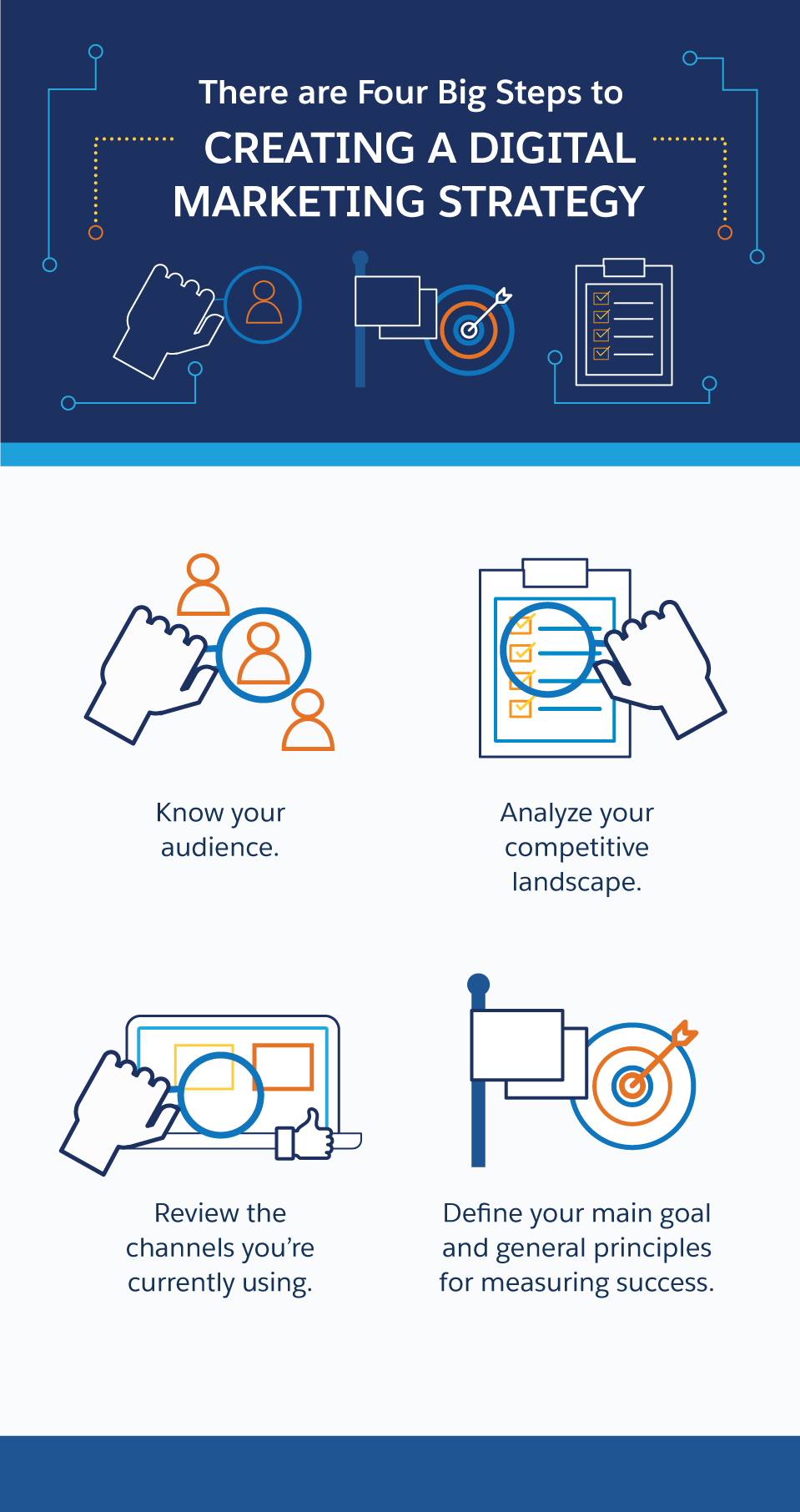
You can’t just throw things up and expect magic to happen. You have to think things through strategically and allocate resources if necessary. What’s more, you can’t expect that all of your customers are accessing digital resources in the same way. Some may be old-fashioned and, on a desktop, or laptop computer, but some may be conducting most of their research and finding information on mobile devices. This graphic outlining the four steps to creating a digital marketing strategy helps offer some insight on the best way to get started.
So, where do you start with your digital marketing strategy?
Before you begin, keep in mind that a perfect strategy is not one that is written in stone. It needs to be comprehensive but adaptable, and you should make tweaks and adjustments as you go. To create a digital marketing strategy, gear up with data about your audience, competitive landscape, current efficiency of your marketing efforts, and the right metrics to track.
Step 1: Know your audience.
In particular, you should know where they prefer to spend their time online and find information.
To engage your audience, you need to do it on their terms. That is, you need to deliver your message through the channels and in the tone of voice they prefer. Moreover, it should align with their customer journey stage. For that, you need to know exactly where they spend their time online and how they search for information. If you don’t know where to start, here are a few effective tips to get you up and running.
Ask your current users.
The power of information gathered directly from your audience can’t be overestimated. This can be done with the help of a quick survey. Depending on your budget, you can select something simple and free like Google Surveys, or go with something more sophisticated. For example, Typeform can turn a simple questionnaire into an interactive opinion survey.
Since your users are busy people, if you really want to receive a substantial number of responses, provide them with value. That could be a product or service discount or an evergreen $10 gift card for Amazon or Starbucks.
Step 2. Analyze your competitive landscape.
No business operates in a vacuum, and to make informative decisions, you need to be aware of your competitive surroundings. Your competitors have likely already built up some online presence, which is the main reason to review which channels they’re using to communicate with your mutual audience. Furthermore, a competitor analysis will help you better understand your current market position and see where your business sits in your industry.
Step 3. Review the channels you’re currently using.
There’s no way to improve something without first analyzing how it performs at the moment. So before turning your findings into an actionable digital marketing plan and setting any KPIs, you need to know how efficiently your channels are currently performing.
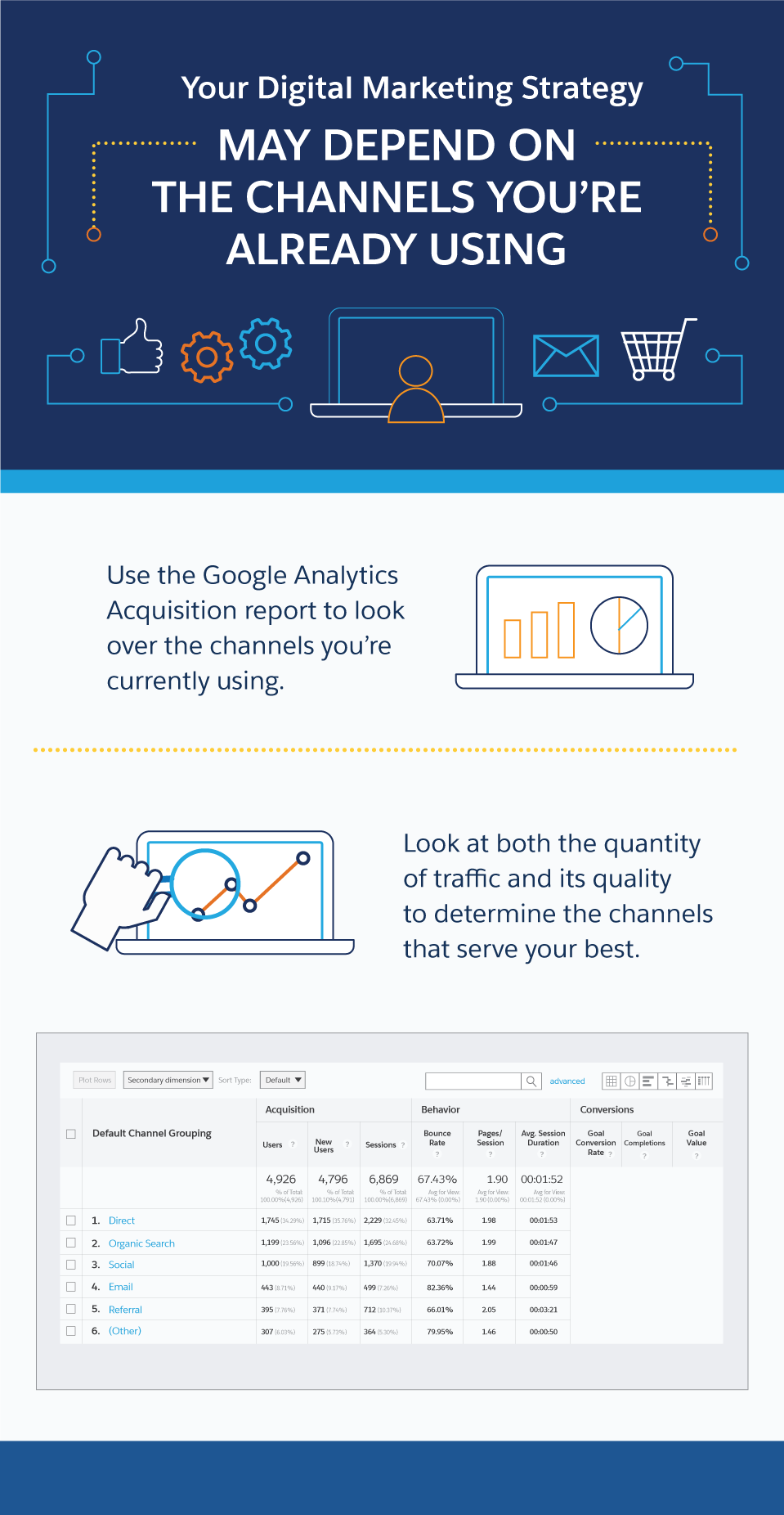
To kick things off, go to your Google Analytics Acquisition report and see which channels are currently working best for you.
Pay close attention not only to the quantity of traffic, but also its quality — that is, consider the number of conversions that each channel earns. For instance, even if referral traffic isn’t generating as many visits as social, the percentage of new visits coming from this channel may be higher. Additionally, this audience may demonstrate more interest if the average session duration and the number of pages per session are a lot higher for referral visits.
Evaluate how much effort it takes to keep the traffic flow from each channel. For example, to get enough visits from social media, your team needs to spend a few hours each day curating content, creating custom images, and engaging with the community. It requires substantial resources. However, the amount of interest from this audience is superficial, and they hardly convert. On the other hand, attracting visitors from other channels might not be as time-consuming.
The bottom line is that with this data, you can make informed decisions and concentrate your efforts on the channels that perform best in terms of the resources spent versus the number of acquired visits and conversions.
Step 4. Define your main goal and general principles for measuring success.
This step is critical for your future work. You need to apply all the findings from the previous steps and define how, exactly, you are going to achieve your marketing goals.
Let’s start from the top: Define your high-level marketing goal. If your company has a mission, your main goal should resonate with it and broadcast your mission to the outside world. For instance, remember the example from the beginning of this post: “Become the go-to website for ordering flower delivery.”
Next, move forward to setting high-level KPIs. For example, here’s a nice KPI template to use:
Template: [Goal] by [value] in [time period]
Example: [Increase traffic] by [20 per cent] in [six months]
After the high-level goals and KPIs are set, you need to deconstruct them with your team into personal goals and KPIs that each team member can achieve individually.
If the high-level goals can be somewhat vague (“20 per cent monthly growth of traffic and conversions”), the individual goals should be clear to the contributor and easily broken down into particular tasks.
Here are a few additional points to consider.
Very often, when the actual goals are not clear to the team, reaching target KPIs becomes the goal. Make sure not to let this happen. Communicate the actual goals to your team, inspire them, and make sure they understand that KPIs are just a way to measure progress. Reaching them is not the sole purpose of their work.
Preach collaboration within your team. For example, if you’re in charge of community management, team up with your colleagues responsible for content and SEO to maximize the efficiency of what you do.
Set up the rules of ethical and low-risk marketing. Everyone, at some point, considers cutting the line in a race for target KPIs. When talking about personal goals with your team members, make sure to communicate which marketing techniques are beneficial for the business’s reputation, and which are not and should not be used.
Over to you
A defined, documented digital marketing strategy is not a necessity. In fact, many marketers do their jobs without having one. However, if you want to maximize the outcomes of your marketing activities, a clear, data-fueled strategy is an absolute must.
Use the tips and information in this article provided by Salesforce to get started, then revise your strategy as you learn what works and what doesn’t. Use your digital marketing strategy to work together toward clearly defined goals and help your team reach those goals faster.
As many of us work from home and are forced to socially distance ourselves, one now has the time to review, define and improve our personal brand. To stand out, to find your next job, to build your network.
Personal branding is the practice of marketing people and their careers as brands. It is an ongoing process of developing and maintaining a reputation and impression of an individual, group, or organization. Even Oprah Winfrey began by going through several iterations of her show before finding her voice and transforming into one of the most influential brands in the world.
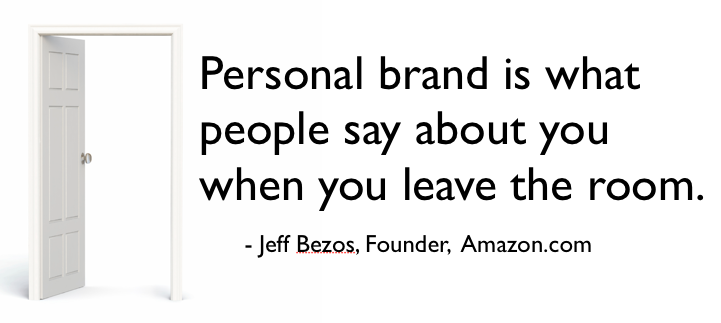
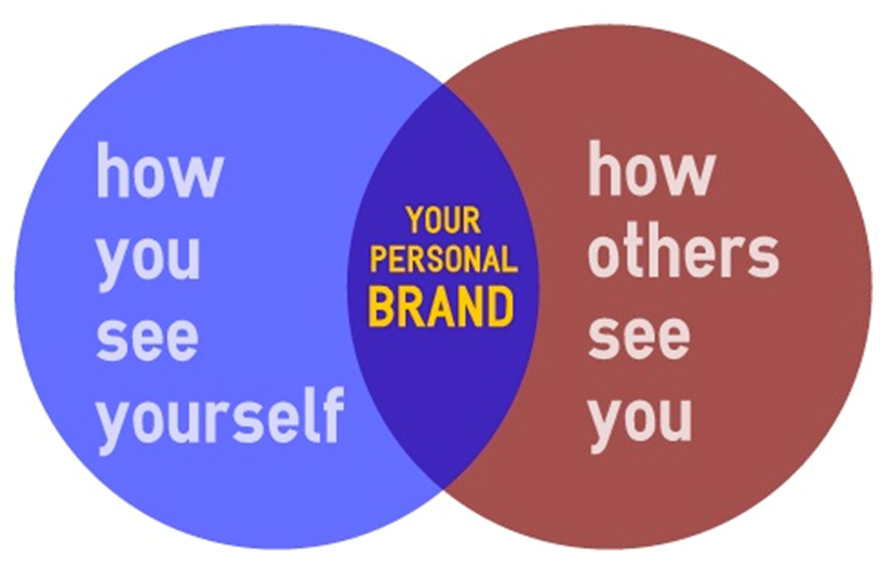
Today, the reality is that your personal brand is linked to social media whether we like it or not. Your personal brand is not solely based on your perspective, but largely on the perceptions from others; your personal brand is the aggregate of positive and negative as seen largely through the lens of others. Remember social media has little to do with what we say about ourselves, and has everything to do with what people say about us.
You’re a brand. I’m a Brand. We’re all brands whether we want to or not. Now to those five tips to help improve all our brands.
Start by defining your personal brand
Too many people are unfocused and trying to be “everything to everyone.” In today’s hyper-competitive world it’s crucial that you build your case of what it is that you do differently. As important as it is to define your purpose, it is of utmost importance to differentiate yourself.
Knowing your personal brand “why” is an important step. Only when you truly know your “why” can you find the courage to take risks needed to get ahead, stay motivated, and define your brand clearly with a rewarding trajectory.
You can begin to define your personal brand by answering these questions:
Who do you want to serve and why?
What are you passionate about?
What are you great at (your areas of expertise)?
How are you different from others within your field?
What unique value do you offer (related to your business)?
Identify your target audience
Once you’ve identified your niche the key is to begin to narrow it down to address a specific demography. It’s crucial to have a clear idea about who your target audience is. Since branding is based on authenticity, you need to understand who you are and what makes you compelling to your target audience aka the people who are making decisions about you.
As you think about what makes you, start to ponder some of the below questions:
What do they want from you?
What are their biggest aspirations?
What are their biggest fears?
What experiences have you had that can help them?
Where do they hang out the most?
What do they associate themselves with?
Conduct thorough research on all these questions and then build your message to best balance authenticity and what your audience might be looking for.
Post Regularly on Social Media
The key to using social media to build your personal brand is to have a focused strategy, set time limits, and continuous reinforcement.
Sharing online allows you to craft an online persona that reflects your personal values and professional skills. Even if you only use social media occasionally, the content you create, share or react to feeds into your public narrative. How you conduct yourself online is now just as important as your behavior offline.
Building your personal brand on social media takes some work, but it can help you land you your next job opportunity or help you to foster valuable connections.
Focus on platforms where your audience hangs out. You don’t have to be everywhere, but you may need to tailor your content based on the platform you’re using – such as images on Instagram, articles on LinkedIn, and a combination of media on Facebook.
Engage with your audience by asking questions, posting discussions, setting up polls, making comments, and replying to comments to keep the dialogue going
Start a private community with your target audience where you can offer help and advice
Join groups relevant to your area of expertise and interact with the members there.
Consistently share your personal brand content by maintaining a social media content calendar.
Spend time on platforms that your fellow influencers run. By engaging within those networks, you’ll increase your visibility with people who can have a valuable effect on your success. And with a clear personal brand, you’ll be able to show them exactly how you can help them and they can help you.
Develop valuable content
Decide which social media account(s) you are going to focus on, and delete any old accounts that you are no longer using. For the networks you will be using, make sure all of your information is complete and accurate. This will help build traffic on the networks you want to showcase your work. It can also remove any potential “questionable” content from years past that doesn’t have a positive effect on your professional image. Before you begin to develop content, think about what you want to be known for. Your digital reputation stays for life, so I encourage you to treat your reputation that way.
Everyone’s an expert at something – whether it’s content marketing or having an in depth knowledge of your favorite TV show. Is it time for you to experiment a bit more? What type of content have you created that your followers have responded to most? Can you replicate this with other similar content? The more unique and engaging content you create on your chosen topic of expertise, the more your followers will start to think of you as a leader in your chosen field.
As you get going with developing content ensure you’re producing content regularly and staying on topic to gain trust. Once you’ve become a thought leader, begin to seek out guest appearances. Working with other relevant people within your field to expand your reach can help tremendously to enhance your personal brand.
Think of being an influencer like being an intern, everyone must prove themselves.
Nobody wants to work with a self-interested, self-absorbed, self-serving self-promoter. Nobody. The days of endless self-promotion are over. The quickest way to lose followers is to constantly promote yourself.
It’s important to seek to promote others and become a curator of content that speaks to your purpose or product with the goal of adding value. Assume everyone can help you.
Always Respond: Conversation > Promotion
Have an opinion online, add value, and become engaged within online feeds.
Follow people, really… it’s okay! And when you get unusual followers (good ones) always reach out!
The very best brands come from repeated trial and error, mistakes and failures and not from instant perfection. My final piece of advice for those of you reading this is to remind you to be ready to fail. Failure is tough, and all of us generally want to avoid it – it’s human nature.
Walt Disney spoke of this when he reminisced about his failed first attempts at creating an animation brand.
“I think it’s important to have a good hard failure when you’re young. I learned a lot out of that. Because it makes you kind of aware of what can happen to you. And what can happen is never as frightening as not trying at all.”-Walt Disney
Defining your personal brand takes time and it doesn’t come easily. Like anything else worth investing in, it takes time, effort, patience and thick skin to make it a success. Learn from failures, but try to fail fast and move on.
It’s hard to imagine a future where social media in whatever form is less prevalent than it is today. Now is the time to spend time defining your personal brand and get started with simple steps.
Regardless of age, position, line of business, all of us need to understand the importance of branding. We are CEOs of our own companies: Me Inc. To be in business today, our most important job is to be head marketer for the brand called You. It’s that simple — and yet, that hard.
Not that long ago, consumers didn’t have information at their fingertips and businesses were often successful in using outbound sales and marketing methods such as cold calling and email blasts to close sales.
And, it’s been revealed that just 16% of organizations that use outbound methods feel it delivers ROI, 44% of direct mail is never opened, and 86% of consumers skip TV ads on recorded shows (Source: HubSpot)- Click to Tweet.
Today, the buyer and the buyer’s journey have changed thanks to the internet of things (IOT) and advancements in technology. Now, 57% of the purchase journey is completed before a customer has even contacted a business (CEB), and 67% of the buyer’s journey is now done digitally (Source: SiriusDecisions). Click to Tweet
Added to this, in 2019, there were 3.48 billion active social media users worldwide, which presents a huge opportunity for businesses to take advantage of.
The rise of social media usage has encouraged organizations to look into ways that can utilize the technology to improve their sales, which has led to the development of social selling.
So, what is social selling and why should you care?
I define social selling as the process of researching, connecting and interacting with prospects and customers on social media networks. It focuses on nurturing leads, building brand authenticity and building trust with your prospects.
Leading firms have taken advantage of social selling and have begun reaping the benefits it offers. Research has shown that 70% of sales professionals are active on LinkedIn for business purposes, 89% believe social networking platforms such as LinkedIn are important in closing deals and 64% of sales reps that invest time in social media are hitting their sales quota (Source: SuperOffice).Click to Tweet
As buyers are becoming more digitally savvy, social selling becomes a no-brainer. But to stand out from the noise on social media, it’s essential to provide value to your audience through high-quality content, insight and real conversations, to enhance each touchpoint that your audience has with you and your business, from awareness stage through to purchase.
What are the benefits that social selling offers?
It appeals to the modern buyer
B2B buyers have 12 to 18 non-human and human interactions along their buyer’s journey (Source: Sirius Decisions) Click to Tweet. 68% of buyers prefer to research products and services online (Source: Forrester) Click to Tweet.
With this in mind, it’s essential that you develop and push information and content on social channels that resonate with your target audience and provide the solution to their problems.
This will enable you to influence their choices and position your business as front of mind.
2. It allows you to build “real” relationships
How many cold calls do you actually answer, listen to and respond to?
If you’re one of those people that frantically hangs up, cursing as you put your phone down you are not alone. Research from Citizens Advice has revealed that 67% of British adults say that have received an unwanted telephone call and 92% of people don’t trust companies whose sales representatives contact them by cold calling. Click to Tweet
With this said, it’s time for businesses to break down the barriers around selling and get on the same page as their customers. Social selling supports this, as through social media listening tools, you’re able to listen to topics and conversations that are relevant to your industry. This technique will not only give you insight into what’s important to your prospects but it’ll also present new opportunities and leads, giving you an easy way to engage and reach out to potential customers in an appropriate, non-intrusive way.
3. Your competitors are already using social selling
71% of all sales professionals are already using social selling tools, so if you aren’t you may be putting yourself at a disadvantage (Source: LinkedIn). Click to Tweet.
For example, Microsoft is one organization that has taken hold of the power of social selling. Their social selling pilot program started with 15 people selling Microsoft Azure through their LinkedIn accounts to find their own customers. This boosted the productivity of their team by 38% and led to the program scaling to 3,000+ sellers.
4. It builds your social capital
Social capital is built when someone in your LinkedIn network has a problem or an issue and they automatically think and turn to you for help. This will happen when you have positioned yourself correctly on social networks with your activity.
To gain social capital you’ll need to consider social proximity, and your connection philosophy. Instead of connecting with just anyone, connect with people in a targeted manner, and with those who you can genuinely help. Next, you’ll need to ensure your social presence is up to scratch.
Present and share your insight and knowledge and contribute towards discussions and groups to build it. This will enhance your online visibility and will strengthen your social capital.
5. The Mere Exposure Effect
The Mere Exposure Effect was first spoken about in 1968 by social psychologist Robert Zajonc. This social phenomenon states that the more a person is exposed to something, the more they’ll develop a preference towards that thing over time.
Social media gives businesses the ability to tap into this theory through regular and consistent posting and updates. When you’ve created and put into action a dedicated strategy, you can begin to utilize social media channels to your advantage and ensure that you have messages trickling through all the channels that your audiences use, creating multiple touchpoints with them.
However, it’s essential to remember to not just share sales messages and calls-to-action. Instead, share content that adds value to your followers, and offers insight and information.
If you fail to prepare you are preparing to fail…
The infamous quote from Benjamin Franklin couldn’t be truer when it comes to achieving social selling success.
To successfully leverage social selling, you need to optimize your social channels to showcase your expertise. And, it’s the little things that make the biggest difference. For example, research from LinkedIn revealed that members with a photo receive 21x more profile views and nine times more connection requests compared to those that don’t. Click to Tweet
So, what do you need to do to give a positive first impression on your social channels?
Here are my top tips:
Post a professional head and shoulders image of yourself
Write your bio/summary to highlight your expertise and what you do on a professional level
Include links to your website and other social channels to encourage visits
Utilize hashtags that your prospects follow
Create lists on Twitter to monitor content from specific accounts
On LinkedIn include your job title and keywords in your headline, ask for recommendations to boost your credibility and join LinkedIn groups that are relevant to your industry and begin networking in them
Social selling best practices
Once your profiles are ready to be rolled out it’s time to kick off your social selling strategy. Effective social selling takes time and must be consistent to build meaningful relationships with your audiences.
Dedicate yourself
Start by creating a plan and setting aside time to dedicate yourself to building your social presence. Being present on multiple social channels can be time consuming, but if you spend 30 minutes every day monitoring your channels, engaging with others and posting content it’ll help ease the pressures and ensure your feeds are always up to date.
Create and stick to a content plan
By creating and sticking to a content plan you’ll ensure that there is structure to your posting on LinkedIn.
The purpose of a content plan is to create meaningful, cohesive, engaging, and sustainable content that engages, resonates and attracts your target audience. In today’s social web environment, getting the right message to the right customer at the right time is crucial. And, to stay front of mind, build rapport and trust and position yourself as an expert, you’ll need to have a solid content plan in place.
Take advantage of social listening
Earlier I mentioned social listening, and it’s essential to factor it into your social selling strategy. So, create and use social lists and monitoring streams to collate what people are saying about you, your company, your industry and competitors, and identify what questions they’re asking and topics they are talking about.
Provide value
Focus your content on providing relevant, informative posts and content, when your audience wants it. This will position you as a thought-leader and build your personal brand. It’ll also help you create relationships with your prospects and gain their trust.
Maintain relationships once you’ve created them
Once you’ve made new connections it’s important to stay engaged with them over time. So, comment on and like the content that is posted by your prospects.
And, be sure to offer advice and guidance to them and contribute to their conversations in a meaningful way if they ask questions.
Share testimonials
Success stories from other customers have a lot of weight, and research from Pretty Links suggests 92% of buyers trust recommendations from peers and 70% trust recommendations from strangers. Click to Tweet
By gaining and sharing third party testimonials you’ll start to build your credibility with prospects and it’s more likely that they’ll begin to trust your business.
Track engagement
Tracking metrics such as likes, comments and shares will allow you to identify the types of content that resonates the most with your audience. And, it’ll enable you to determine if your social selling activities are paying off.
In addition, by establishing what content is getting the most engagement you can adjust your content so that you’re producing more of what is preferred by your audience. For example, if you notice content about a particular topic is getting high levels of engagement, this will suggest that your audience is interested it in, so why not produce more and give your audience what they want?
Understand when to take your connections offline
To land a sale you’ll need to escalate the connection with a prospect by offering them a call to continue the conversation offline and on a deeper level. And, it’s important not to try and push a call before prospects are ready as this will damage all of your nurturing efforts.
This week G2 Planetand my colleague Tom Pick published an article entitled TheBiggest Trends in Event Technology for 2020 — Per 10 Top Events Experts. I’m thrilled that my insight was included as one of the event experts within the post. My “expert” opinion is that as we enter 2020, data will still remain king and crucial for ongoing event success. I also think personalization is crucial to enhance the overall event experience.
The article found that the biggest event technology trend is the use of integrated and aggregated data, bringing together information from multiple devices, event apps, event management platforms, social media, and back-end systems like CRM applications (which is, incidentally, exactly what the G2Planet platformwas been built for) to give event professionals a holistic view of what’s happening tosupport data-driven decisions at both the operational and strategic levels.
Check out the fullarticle to see the insights from the other event professionals included. Below is the insight I shared within the post:
Data remains top-of-mind and crucial for event success into 2020. Successful companies are using analytics tools such as social listening, mobile apps, lead generation, and more to better meet the needs of their clients and personalize and improve the overall experience.
Pre- and post-event surveys are helpful to collect data and suggestions to help shape the agenda, collect feedback, and more, but successful companies will capture data in real time.
Geolocation data can help to personalize the event experience by highlighting activities attendees can check out nearby, alleviate overcrowding and event bottlenecking within specific spaces, send push notifications, collect input and more.
In the past I’ve used technology to collect responses from attendees in real time and develop custom graphics for our social media channels to collect our onsite and virtual audiences. Numerous technologies allow delegates to respond in real time and engage with the event to gamify the experience while providing insight to help shape their experience. Personalizing the event experience is key for success and can help to solve real-time event problems and create a memorable experience for delegates.
As a reminder, this is just a sample and I encourage you to check out the full article by visiting the following link.
What do YOU think the biggest trends will be in event technology into 2020. Leave a comment below.
Tom reached out to me over the summer asking for my advice regarding what would help me to do my job more effectively. I thought for a few days before sharing my feedback with him. After receiving responses from several other thought leaders he found that several of us mentioned things like needing more hours within our day, many expressed a desire for more support and understanding from management and clients. All of us featured provided an array of answers and I shared the below advice:
“More hours in my day!
Seriously, sometimes days fly by and some days drag on, but when it comes to events it’s always that last minute rush of things coming together which can prove challenging at time.
I often find myself in a last-minute crunch and having to prioritize what really needs to get done at any given time. With two kids and my own consulting business, I’d say I’m a multi-tasking Momma, and working smarter and not necessary harder at all times is what’s helped me to get ahead over the years.”
What do you think? What would help you work more effectively? As my children are both back to school and settling into new routines I’m reflecting on my advice and enjoying reading other’s insight and commentary. The photo below was taken after my older son’s Lucas first day at his new school. We walked down the path to my car together as he told me all about his day and he reflected upon his day within a new environment with new teachers and friends. As he described his day it was refreshing to hear a fresh perspective from someone taking it all in, a sponge if you will. I constantly try to work more effectively and clean in and reflect, prioritize and improve and as I settle into my new routine I hope to continue to do so into the end of the year.
Guest Post: Understanding Your Customers by Jenna Hegarty – Adtaxi
As digital advertisers, we are constantly trying to determine the optimal targeting for our SEM efforts. Understanding your customer personas, the profiles that represent your ideal customers, will help you tailor your digital marketing efforts and set your campaign targeting effectively.
While there are a handful of methods you can use to understand your customer base, including market research, surveys, polls, and social listening, one of the best ways is to dive into your site & campaign analytics. Google offers two tools that can help you quickly understand your audience: Google Analytics & Google Ads Audience Insights.
Using Google Analytics for Audience Research
Google Analytics is a rich source of information about your customers. You can see where your site visitors came from, which terms they searched to find you, how much time they spent on the site & more. You can also find valuable information on your customers’ interests, age, gender, location and even which device & browser they used.
Audience Reports in GA
Google Analytics Audience Reports give detailed information about who visited your site. Audience Reports contains over 15 subsections, but we will focus on Demographics & Interests here.
The Demographics report gives you insight into the age and gender of your site visitors, and each demographic group’s behavior on the site. The overview gives you a high level demographic breakdown of users by age and gender, and you can toggle through other key metrics like sessions, bounce rate, and session duration as well. The Age & Gender reports give a more granular look at each age group’s or gender’s behavior on your site, including bounce rate, pages per session, duration, and goal completion.
The Interest report in turn gives you a psychographic view of your audience. Google Analytics segments interests into three categories: Affinity, In-Market, and Other. Affinity includes users with a more general interest in topics, such as “Cooking Enthusiasts” or “Travel Buffs.” In-Market includes those users at the bottom of the funnel who are ready to convert, with more specific segments like “Home Decor” and “Hotel & Accommodations.” Other categories is similar to Affinity, but provides a more granular view, for example “Home & Garden/Bed & Bath/Bedroom/Bedding & Bed Linens.” Like the Demographic overview above, the Interests overview breaks down key metrics by each of the top ten interests in each category, and you can drill down into each category’s report acquisition, behavior, and conversion metrics.
Understanding the demographic & psychographic composition of your customers will not only ensure your campaign settings target the users with the highest conversion or goal completion rates, but also inform the creative, ad copy, and overall messaging of your marketing efforts. These reports can also help you gauge whether your campaigns are, in fact, sending the right visitors to your site. You can even use age, gender, and interest segments to create remarketing audiences to use in Google Ads.
Using Google Ads Audience Insights for Audience Research
The Google Ads audience insights tool helps you learn about who your converters and website visitors are, as well as find new audiences to target. Audience Insights is housed in the Shared Library under the Audience Manager.
Google Ads Audience Insights report
The Audience Insights report is a valuable resource for determining where, when, and to whom you should be advertising your products or services to drive conversions for your Gmail, YouTube, & display campaigns, and can also help you choose more relevant keywords & messaging to implement in your search campaigns, set bids, and more. Audience Insights benchmarks your website visitors against the United States on demographics, location, devices and interests. For example, the traffic for one of our clients in home goods retail is 66% more likely to be female and between 35 to 54 years old, 42% more likely to be parents, and 76% more likely to be visiting from a computer than the general US population. We also know that our visitors are 10.3x more likely to be in-market for “Kitchen & Bathroom Counters” and 3.2x more likely to be “Beach Bound Travelers.” Armed with your customer persona, you can leverage your findings and refine your paid media strategy to drive high-value traffic to your site.
Once you’ve created your customer persona, continue to periodically review your data in Google Analytics & Google Ads. Buying habits & preferences can change over time, so it’s important to reevaluate and recreate your personas especially if you’ve gone through new product launches or industry changes.
********
Adtaxi is a client-centric digital organization that brings scale, precision, and sophistication to digital marketing. Leveraging the belief that people matter as much as technology, we help advertisers solve complex marketing challenges with custom, performance-driven solutions. Adtaxi just recently won Digiday’s Worklife Award for Most Passionate Employees at an agency!
Guest Post from Matt Gibbs, Co-founder and CMO of UPshow
Millennials and GenZ might be the curated selfie generation, but a shift is happening, and businesses are taking notice. The cultural pendulum is swaying away from brand-sponsored mega-influencer-celebrity-endorsed posts to organic content that’s generated by people you know, or even those you feel like you know. Capturing more natural moments and promoting them within a more intimate circle of followers versus big ‘on the main stage’ posts is what’s now in-vogue. An industry 2018 Trust Barometer Report revealed that 60 percent of people no longer trusted social media and reported that immediate friends and family are better for recommendations than influencers.
That said, Kylie Jenner-esque paid posts aren’t going away, but they have become tarnished, and millennials and their younger counterparts are gravitating towards more natural interactions from those within their inner circle or for relatable micro-influencers. As a result, more brands are gravitating toward user-generated content to increase engagement and build trust and community.
According to a study, 56 percent of consumers are more likely to buy a product that they’ve seen in real-life images posted by another consumer – a shift away from the rainbow-colored preplanned photos that dominated platforms like Instagram in late 2017.
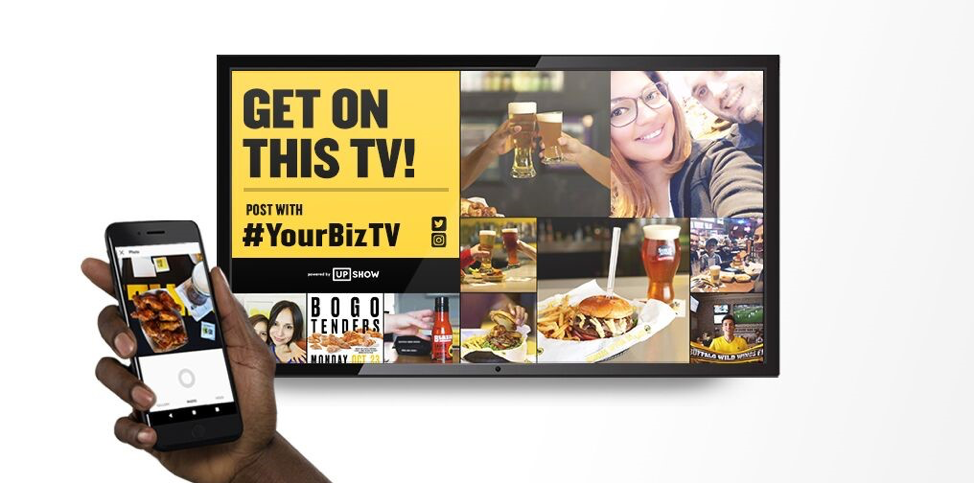
UPshow, the company I co-founded, is a social TV platform that companies such as Crunch Fitness, Cheddar’s Scratch Kitchen and ATI Physical Therapy are using to transform their customers into immediate influencers. The platform entices customers to post on social media by projecting them on big screens in-venue. As a result, friends and family, also see and are often influenced by the posts. The content and choice to participate is totally in the hands of the consumer.
Other companies also provide services that cater to this trend, such as Guest Crew and Woobox. Their platforms harness user-generated content and boost it organically. Guest Crew leverages a community of organically generated influencers and Woobox turns user-generated content into contests. Filtergrade uses professional photo grade filters (such as Adobe Lightroom presets) to help brands generate more professional quality shareable images that are unique and micro-influencers can use them too to make their posts mimic celebrity influencer quality.
It’s a new era for user-generated content and if brands want to appeal to younger audiences, such as millennials and GenZ, they need to embrace the social media trends that will improve their engagement rates by putting the power in the hands of the consumer in a genuine way.
********
Matt Gibbs is co-founder and Chief Marketing Officer of UPshow, a consumer engagement platform that transforms a business’s existing TVs into its top marketing assets. Gibbs is responsible for branding, lead generation and advertising for the
company. Gibbs is a genuine entrepreneur and trailblazer in digital media with deep roots in the Chicago start-up community. Along with college friend and UPshow CEOAdam Hirsen, Gibbs co-founded SparkReel in 2011. SparkReel created a more efficient way for friends and family to share mobile videos online and evolved into a social media agency that created user-generated content campaigns for Verizon, Oreo, Condé Nast, Apartments.com, among others. UPshow was born out of SparkReel when customers wanted social media engagement screens at events. Gibbs graduated from Miami University of Ohio and resides in Chicago, IL with his wife, two children and corgi.









 Marissa's Picks